Published on 01/01/2022 || Episode 5
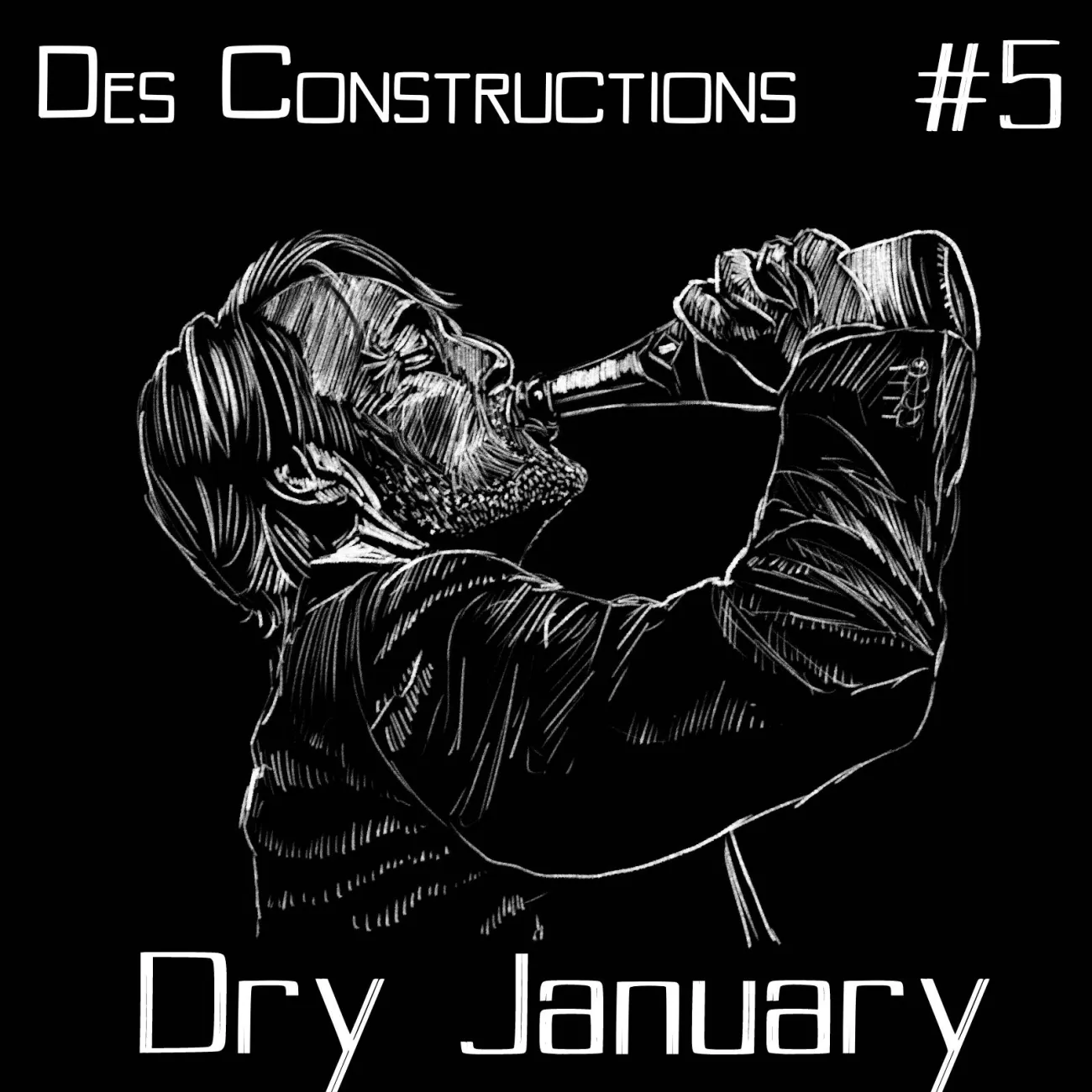
January is the season of New Year’s resolutions. Every year, here and there, you hear people declare that “this year I’m going to cut back on drinking”, and that resolution takes the form of a month without alcohol: Dry January or Belgium’s Tournée Minérale.
This podcast sets out to spark (or rekindle) questions in you. For maximum accessibility and inclusivity, you’ll find the full script of the episode below — though I of course encourage you to listen to it if you can.
At the bottom of the page you’ll find a list of the resources I consulted while writing this episode, along with a few recommendations on the subject, should you wish to deepen your understanding of it.
Translated transcript
Here we are in January. The start of a new year is also the time for New Year’s resolutions.
Ever since launching this podcast, I’ve been waiting to talk to you about this month’s topic. It’s something that’s been part of my life for almost 22 years, which is more than half my life. Because today, we’re going to talk about alcohol. Or rather, about the consequences of its absence.
There were several easy angles I could have taken to talk to you about alcohol!
I could have talked about collateral damage. I grew up with an alcoholic father who drank every day, and alcohol made him anything but cheerful, believe me.
I could have talked about the sadness of losing a friend, killed on the road on the way back from a night of too much drinking. The feeling you get when you receive that phone call from a former classmate to tell you, when we were only 18.
But I don’t intend to talk to you about alcoholism. It’s a very complex subject… It’s an illness. I’m not even going to try to define alcoholism here, although I’ll add links in the notes, because we often tend to downplay our drinking and the point at which it becomes a symptom.
During this pandemic, during the lockdowns, many people found refuge from isolation in alcohol. That’s understandable given the situation. But while last summer everyone (or almost everyone) saw the reopening of café terraces as a return to freedom… while everyone (or almost everyone) was celebrating the return of after-work drinks… I have to admit I was tempted to let out a timid “meh…”.
No, I’m not going to talk to you about what drinking alcohol means. I’m in no position to. Nor about the excesses, side effects and other potential problems that sometimes come with it. That’s a different subject.
What I want to talk to you about is the choice not to drink alcohol, and the impact it has on interactions with other people. And I know a thing or two about it… I haven’t been drunk in 22 years, since a day in April in the year 2000. In the few years that followed, I did sometimes have a little alcohol, on very, very rare occasions, but never more than a single glass. But what I really wanted eventually won out, and I haven’t had a single drop of alcohol since 2017.
I had no trouble at all giving up alcohol, and for good reason: I didn’t have any addiction problem.
It’s just that one day I understood why I was drinking: social convention and a desire to belong to the group. That reason seemed neither sufficient nor satisfying to me. So I decided to stop. And the more people tried to convince me otherwise, the more sensible that choice seemed.
What was complicated, though, was facing other people’s incomprehension and insistence. And you can’t imagine how constant and insidious it can be if you’ve never made the decision to confront it.
Alcohol is such a social marker that we give it as a present!
You have no idea how many bottles of wine guests have given me.
You have no idea how many cups of beer audience members (and I’m not being inclusive here, because they were only men) have tried to put in my hands, almost by force, as I was coming off stage after a gig.
How many alcohol tastings, beer or otherwise, have I been exposed to in supermarket aisles? Sometimes even at 11 in the morning!
Let’s not even talk about the drinks packages received during Covid for company parties on Zoom…
There’s no shortage of examples…
But… what if I were an alcoholic?
What if I were in recovery and people were cheerfully pushing alcohol into my hands, very regularly and without my consent?
It’s unacceptable and shows not the slightest consideration.
People assume that every halfway decent person must love alcohol.
After all, that’s how you spot someone who knows how to enjoy life, right?
That’s why, often, when you’re invited somewhere and it’s time for drinks, if you don’t drink alcohol, you get water or “something lying around in the fridge”.
I’m so sick of hearing gendered stereotypes… like “drink like a man”. If the person saying no is someone with a uterus, people will automatically wonder whether she’s pregnant, as if that were the only possible and acceptable reason. I even wonder whether my rejection of alcohol was an early sign of my rejection of gender, which I talked about in the first episode.
What I can tell you about is the feeling of emptiness and isolation you get amid the vacuity of a heavily boozy evening. You have to choose your nights out sparingly, and you have to know when to admit defeat and leave the party once it turns into a drinking session.
It’s the anger you feel when you hear, yet again, someone using alcohol to excuse their awful behaviour. Because whoever has been drinking forgets what happens during a night of heavy drinking, forgets what was said, but the sober person forgets nothing. So you’re forced to let certain things slide, or choose to distance yourself.
Add to that the frustration of watching someone who knows full well they become unmanageable when drunk get wasted and overdo it without any remorse.
But it also means seeing vulnerable people whom others seem determined to take advantage of, whether just to make fun of them, or for something far worse. A responsibility to keep watch when everyone else seems checked out.
It means being the killjoy, the one people tell “you’re not going to let me drink alone, are you! ” because damn it, alcohol’s a social thing, isn’t it?
And here we are at the heart of the problem. Alcohol is a social lubricant. It’s a mask we wear. Alcohol is an injunction. It’s constantly thrown in our faces, whether in films, in TV series, or in the hypocrisy of ads that invite us to drink responsibly…
And yet, believe me… when you’ve turned down as many drinks as I have, you understand that the issue lies elsewhere.
When I turn down a drink, despite how insistent people can be, it’s as if I were telling the other person that they have a problem. As if my refusal were a veiled accusation. And that… isn’t so easy to take. Seeing someone refuse to go along with a social convention always makes people uncomfortable. As if we were breaking a moral contract we’re all expected to sign up to. People wonder “why not?” “If they’re saying no, they must think I’m doing something wrong!”… the feeling of being judged sets in, even though it’s not necessarily based on anything real.
I’m not judging your choices; everyone is free to drink alcohol within the limits that feel right to them. I don’t even have anything against parties planned as drinking sessions, I just stay away from them.
No, what really bothers me is that my choices are constantly being questioned, and that nobody asks for consent before putting alcohol in the hands of people for whom it may be a problem, as if all of this were normal.
Alcohol obviously has to remain a personal choice; let’s not turn it into a barely disguised obligation.
So I’ll be smiling again all month as I watch Tournée Minérale, Dry January and the like multiply. I’ll be sighing at the mocking comments that will follow.
But please, if your story or anecdote starts with “I’ve got to tell you, we were completely wasted… ” then spare us both the embarrassment: I’m not interested, and I’ve already stopped listening.